
Courses / Bleeding Control Basics
Members course · Certificate of completion
Bleeding Control Basics: What to Do Until Help Arrives
What to do in the first minutes after a serious injury: stay safe, call 911, find the bleeding, apply pressure, pack a wound and use a tourniquet. Five short lessons with an experienced instructor, a 15-question quiz and a certificate of completion.
Included with membership: every course and the security job board for $9.99 a month or $89.99 a year. See plans
This course is general awareness information. It is not a certification in first aid, CPR or bleeding control, and it does not replace a hands-on class. In an emergency, call 911 first and follow the dispatcher's instructions.
- 1Why bleeding control matters Video4 min
- 2Safety first, call 911, find the bleeding Video4 min
- 3Direct pressure and wound packing Video4 min
- 4Tourniquets 2 videos5 min
- 5After the bleeding stops, and being ready 3 videos6 min
You've completed this course. Your next steps:
Resources and next steps: official links for licensing, training, jobs and more, with what each one is for.
Taught by an experienced instructor
Video from Hire Police's hands-on trauma class, with the steps written out from official guidance.
Awareness, not certification
This course explains the steps. A hands-on class is where you practice them; links are at the end.
Certificate
Pass the 15-question quiz (80% or better) and download a certificate of completion as a PDF.
Who it's for
- Restaurant, retail, hotel and office staff
- Security officers and front desk staff
- Coaches, teachers, parents and volunteers
- Anyone who wants to know what to do before help arrives
What you'll learn
- Stay safe and call 911, or have someone call
- Find the source of the bleeding
- Press, pack or use a tourniquet to control it
- Stay with the person until help arrives
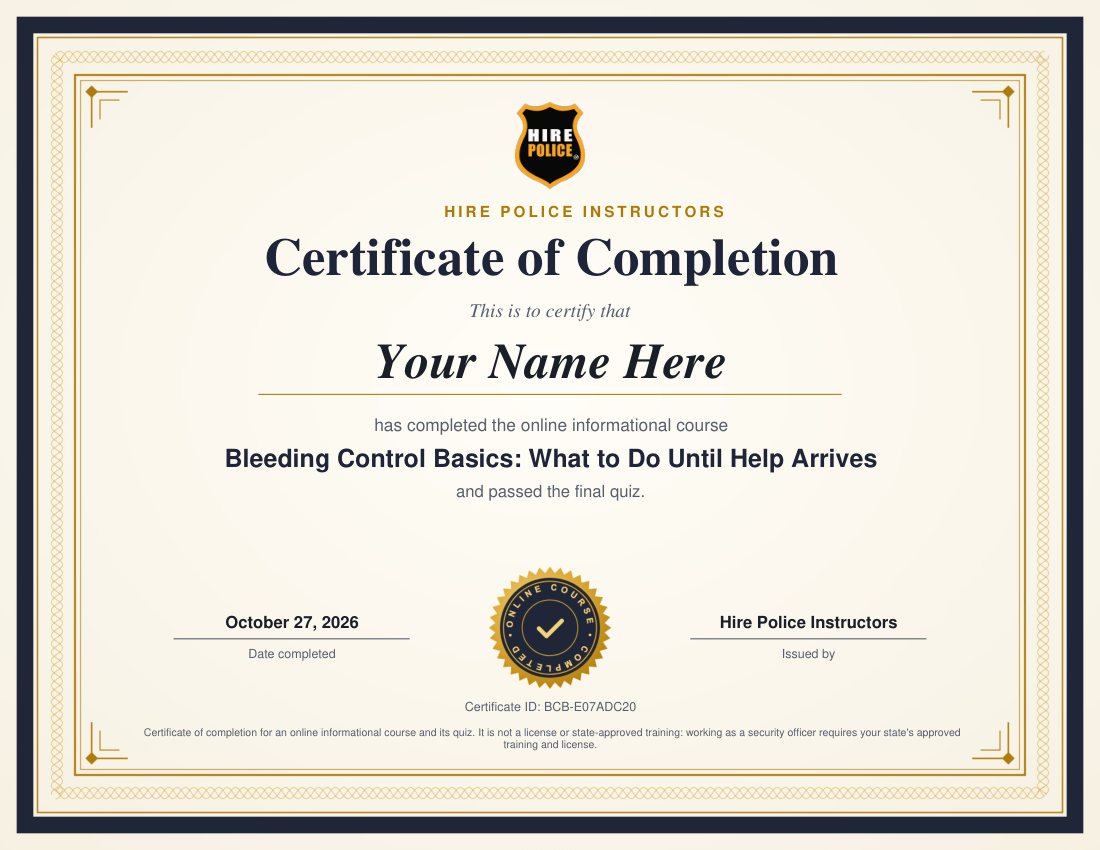
The certificate you'll receive
About the certificate
The certificate shows you completed the course and passed its quiz: something to show employers you took the time to learn. It is not a license or state-approved training, so to work as a security officer you will still complete your state's required training and licensing.